
How to Host a Retreat in Bali: Venues, Pricing and Guest Logistics

Knowing how to host a retreat in Bali starts with getting the operating plan right. The venue, guest numbers, accommodation, pricing and arrivals all affect one another. Make those decisions in the wrong order and a promising retreat can become difficult to run before anyone arrives.
For established yoga, wellness, surf, coaching and creative retreat hosts, the practical sequence is straightforward: choose your location and venue, calculate the real cost per guest, set booking rules, then organise payments, rooms and arrival logistics.
Here is how to build a Bali retreat that works for your guests and your business.
Start with the Bali region and retreat format
Choose where to host in Bali based on your programme, guest profile, transfer requirements and the type of venue you need. A beautiful property is not necessarily a practical retreat venue. Your location should make the daily schedule easier to deliver, limit unnecessary travel and give guests suitable accommodation and shared spaces.
Ubud for contained retreat programmes
Ubud is a natural starting point for yoga, meditation, wellness and workshop-based retreats. Many programmes can operate largely within one property, with accommodation, meals and practice spaces close together.
Check whether the venue offers exclusive use of the practice space, suitable dining arrangements and enough quiet areas for your group. Also consider airport transfers and travel time for any offsite activities.
Coast for surf, fitness and beach-led formats
Coastal areas such as Canggu and Uluwatu can suit surf, movement and outdoor fitness retreats. Your choice should depend on access to the activities guests will actually undertake.
If sessions happen away from the accommodation, plan transport around lesson times, traffic and group size. A cheaper villa may become more expensive when daily vehicles and drivers are included.
Remote venues when the property is the programme
Quieter locations can work well when most activities, meals and workshops happen onsite. They may offer more contained group time, but can also make transfers, supplier access and last-minute arrangements harder.
Season matters too. Indonesia's official tourism guidance describes April to October as Bali's typical dry season and November to March as its wet season, while noting increasingly unpredictable conditions. Check suitability for your specific dates rather than relying entirely on seasonal labels.
Compare Bali retreat venues by what is actually included
Compare Bali retreat venues by the total cost of running your programme, not just the advertised nightly rate. A quote needs to account for accommodation, meals, staff, taxes, practice spaces and any additional services. The cheapest property can become the most expensive option when essential retreat requirements are charged separately.

Whole-property hire vs per-room booking
Whole-property hire gives your group access to the agreed property and facilities, but can leave you paying for unused capacity. Per-room arrangements may reduce that exposure, although exclusive use of shared areas may not be guaranteed.
Ask each venue to quote against the same dates, expected headcount, room configuration and meal plan. As Basundari's venue pricing guide explains, group size, nights, dates and inclusions all influence the final quote.
For a concrete example, RenewBali's published host pricing lists a property buyout of IDR 19,200,000 per day, food at IDR 480,000 per guest per day, plus 10% hospitality tax and a 5% service fee. These are one venue's published figures, not an average Bali retreat rate. Confirm current prices and how charges apply before budgeting.
What to ask before paying a venue deposit
Which rooms and shared facilities are included exclusively?
Are meals, dietary alternatives and drinking water included?
What staff, equipment and workshop spaces are available?
Are taxes, service charges and cleaning included?
What are the minimum stay, deposit and cancellation terms?
Can the venue accommodate your proposed room-sharing arrangements?
Get every inclusion and payment deadline confirmed in writing. Your venue contract becomes the foundation for your retreat pricing and guest booking terms.
Build your Bali retreat price from fixed and variable costs
Build your Bali retreat pricing from the break-even guest count, room mix and margin your business needs. Start with costs you must pay regardless of attendance, add expenses that increase per guest, then calculate what each accommodation category needs to earn. Avoid choosing a ticket price purely because a competing retreat charges something similar.
Fixed costs
Fixed costs may include property hire, host travel, facilitator fees, venue setup and essential equipment. Divide these costs across a realistic break-even headcount, not the maximum number of guests the property can hold.
Per-guest costs
Meals, airport transfers, activities, welcome items and some payment costs increase as bookings grow. Calculate each against the actual number of paying guests and the supplier's billing rules.
Keep a contingency allocation for supplier changes, transport delays and replacement purchases. A contingency is protection against uncertainty, not profit.
What to include in a Bali retreat budget
Cost category | Typical examples | Pricing treatment |
|---|---|---|
Fixed | Venue buyout, host travel, facilitator fee, setup | Divide across break-even guest count |
Per guest | Meals, airport transfers, activities, welcome items | Multiply by expected guest count |
Booking and payment | Payment processing, booking fees where applicable | Include in per-booking maths |
Room mix | Private upgrade, shared occupancy, single-use rooms | Price by room type and capacity |
Contingency | Supplier changes, transport delays, small replacements | Hold a buffer, do not treat it as profit |
Room tiers and occupancy
A private room usually consumes more accommodation capacity per guest than a shared room. Your pricing needs to reflect that difference without leaving shared spaces unsold or accidentally relying on double occupancy that never materialises.
Model several booking outcomes. Can the retreat cover its commitments with fewer guests than expected? Does the room mix still work if private rooms sell first?
Deposit and final-balance timing
Map venue and supplier payments against the dates guests pay you. A large venue balance due before guest final payments can create a cash-flow gap, even when the retreat is profitable on paper.
Set payment dates that support your obligations and communicate them clearly before purchase.
Set room types, deposits and booking rules before launch
Your retreat booking rules should reflect the venue contract, available room capacity and supplier payment deadlines. Decide the private and shared room options, occupancy prices, deposit amounts, payment schedule, cancellation terms and booking cut-off dates before guests can reserve a place. Clear rules prevent overselling, payment confusion and disputes later.
Private vs shared rooms
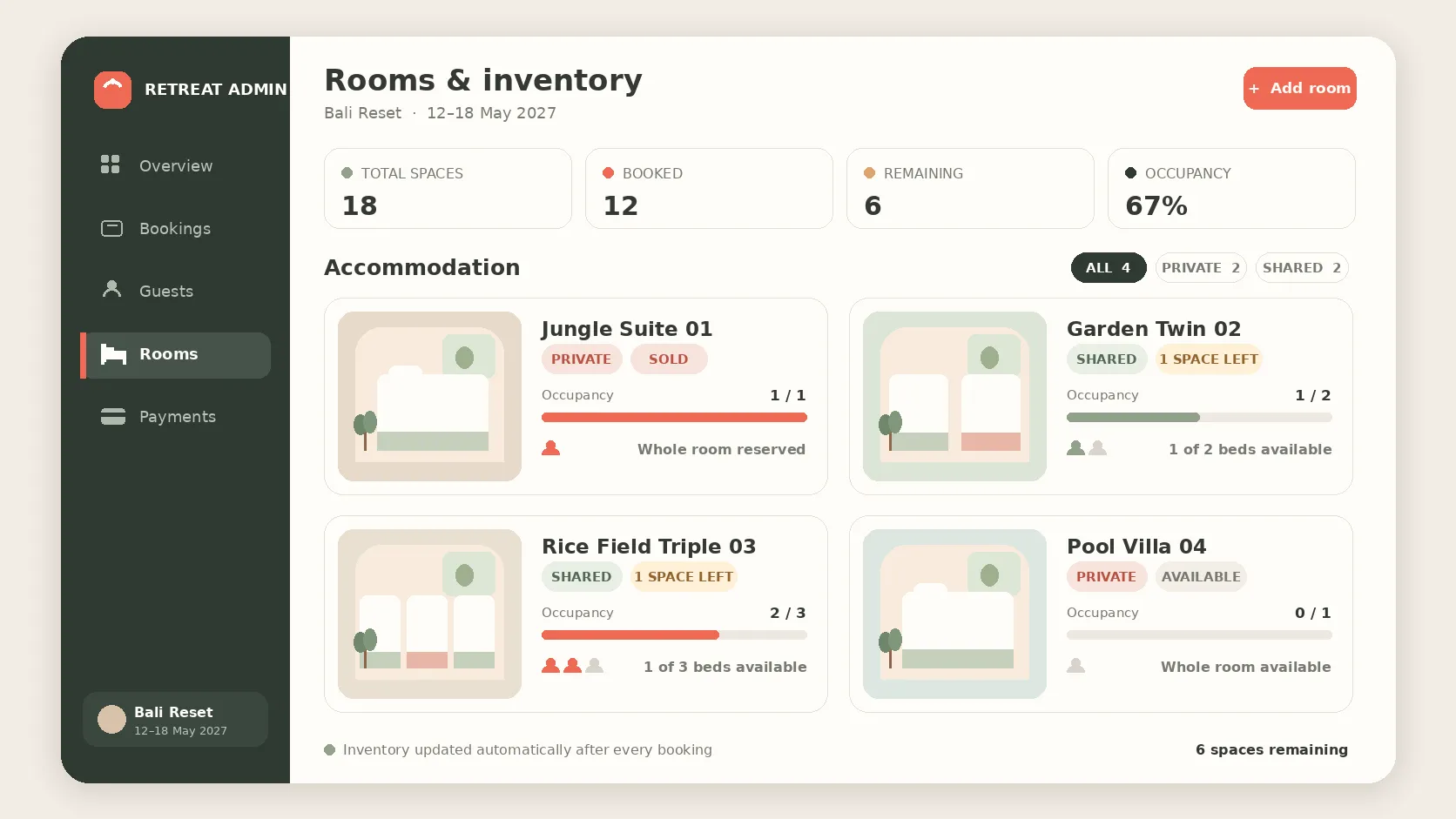
Confirm exactly how many guests each room can accommodate. Specify whether shared rooms are sold individually, whether guests can request a roommate and what happens when a sharing arrangement cannot be completed.
Accurate retreat room bookings should show available accommodation by room type and occupancy rather than treating every guest as an identical booking.
Match guest payment dates to supplier deadlines
Work backwards from the venue's deposit and final payment dates. Set guest deposits, instalments and final balances with enough time to meet those commitments.
Document refund terms and deadlines clearly, including what happens if a guest cancels or the minimum viable group size is not reached. Guests should understand the payment commitment before they confirm their place.
Plan guest arrivals, entry requirements and transfers
Give every guest one clear pre-arrival checklist and collect the information you need before transport arrangements must be finalised. For Bali, that means checking passport and visa requirements, applicable visitor charges, arrival declarations, flight details and transfer choices. Avoid leaving essential instructions scattered across emails and messages.
Entry requirements depend on nationality and activities. As one example, Ngurah Rai immigration guidance describes a Visa on Arrival costing IDR 500,000, with a 30-day stay and one possible 30-day extension for eligible travellers.
That does not establish permission to host, teach, speak or undertake commercial work. Retreat hosts and facilitators should confirm their correct visa category directly with Indonesian immigration or a qualified adviser before travelling.
Other arrival requirements include Bali's IDR 150,000 foreign tourist levy for eligible international visitors and Indonesia's All Indonesia arrival declaration, which official customs guidance says can be completed from three days before arrival. Recheck official guidance close to departure.
For transfers, establish a flight-information deadline, identify the arrival airport and agree collection windows with your transport provider. Decide who handles delayed flights, guests arriving outside group transfer times and last-minute changes.
One accurate arrival document is easier for guests to follow and easier for your team to update.
Collect guest information before you need it
Build one structured guest intake process instead of collecting important details across messages, emails and spreadsheets. Request information when it becomes relevant, set a clear submission deadline and give your team a consistent record to work from. This reduces mistakes when preparing meals, assigning rooms, booking transfers and distributing essential documents.
Your guest intake should cover dietary requirements, allergies, emergency contacts, signed waivers, room-sharing preferences, flight information and any names that must match travel or supplier documents.
Keep each request proportionate to what you need to deliver the retreat. Make it clear why information is being collected, who needs access and when guests should update it.
Prepare the practical trip documents too: venue address, arrival instructions, packing guidance, programme details and a contact for travel-day problems. Give guests a reliable place to find the latest versions rather than sending repeated attachments.
Keep bookings, rooms and guest logistics in one system
A retreat host should be able to check room availability, deposits, outstanding balances, waivers and guest information without opening several disconnected systems. That becomes especially important when one Bali retreat includes different room prices, instalment dates and transfer requirements.
Gather's retreat booking software brings dates, room inventory, bookings and payments into a branded booking flow. Guests can select available rooms and complete the relevant booking steps, while hosts manage reservations and payment information together.
The guest portal also gives guests access to forms, waivers, trip documents and balances. This helps reduce the repeated follow-up work that builds up between taking a booking and welcoming someone onsite.
For hosts comparing the financial side, Gather pricing publishes a flat monthly fee plus 2% per booking, with the commercial terms confirmed in writing before signing.
Make the next Bali retreat easier to run
Bali retreat planning already involves enough moving parts without splitting room inventory, deposits, waivers and guest details between separate tools. Gather Software connects dates, rooms, bookings, payments, payment plans and guest intake through a branded booking flow on your own website. Guests can access their forms, trip information and balances, while your team keeps the essentials organised. For independent hosts and smaller retreat centres managing multiple dates and room types, that means less time reconciling bookings and more time preparing the retreat itself.
Book a call to see whether Gather fits your next Bali retreat and wider retreat calendar.
Frequently Asked Questions
See where you are leaving bookings on the table
Book a call and we will tell you honestly whether Gather fits, and what to use if it does not.